Coral taxonomy, or the scientific naming and grouping of corals, is primarily a realm for the scientific community and those hobbyists who really like to get into the weeds. While I consider myself part of the latter, I also think there is some extension of taxonomy that impacts the common reefer.
Take for example SPS corals, or even more specifically a group of SPS such as Acropora. Not all Acropora are the same and may have different lighting requirements, flow requirements, and parameter preferences. They are located in different parts of the natural reef ecosystem such as deep water, sheltered reefs, turbid tidal zones, etc. So brushing all Acropora with a broad stroke statement such as “high light, high flow” is neither accurate nor will it lead to the best results for all specimens. These are cases where taxonomy can help along with data points such as coral collection locations, and more detailed and specific care requirements by coral vendors.
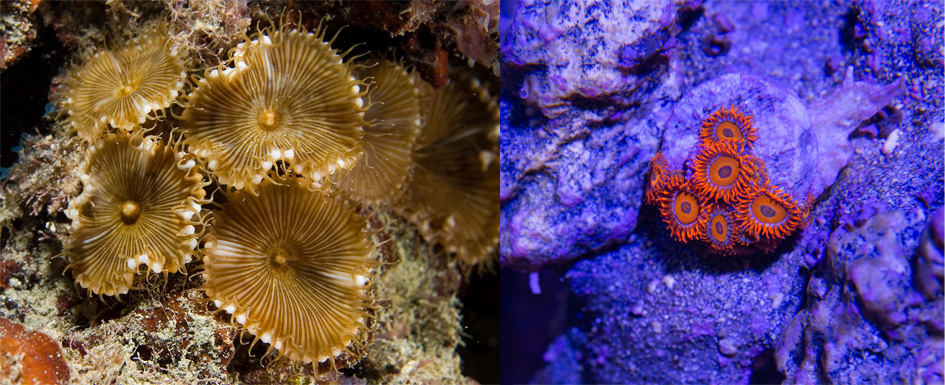
Palythoa on the left, Zoanthus on the right.
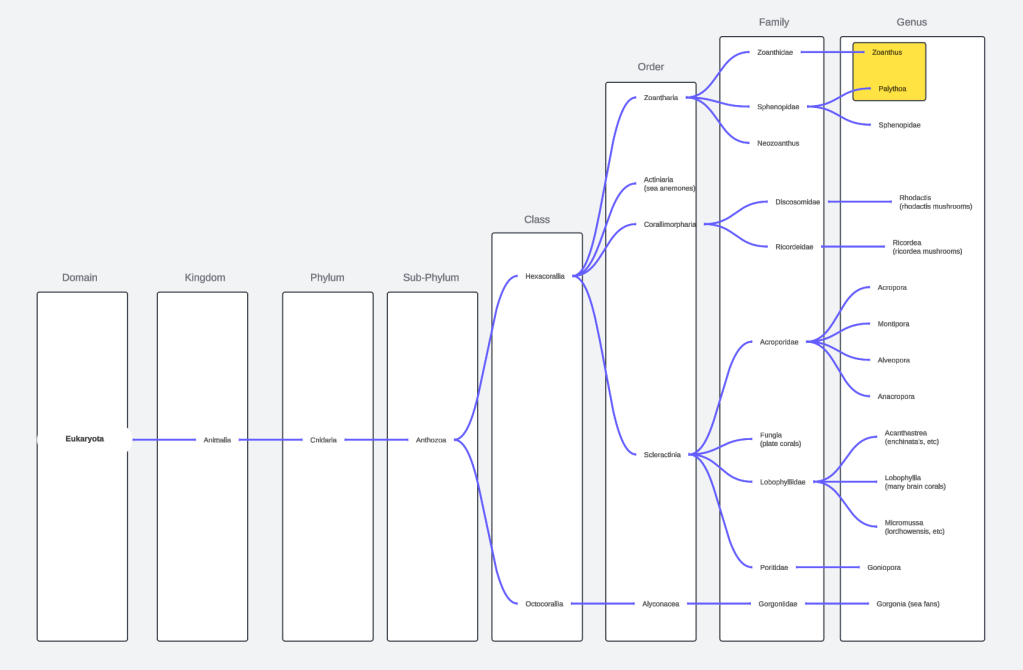
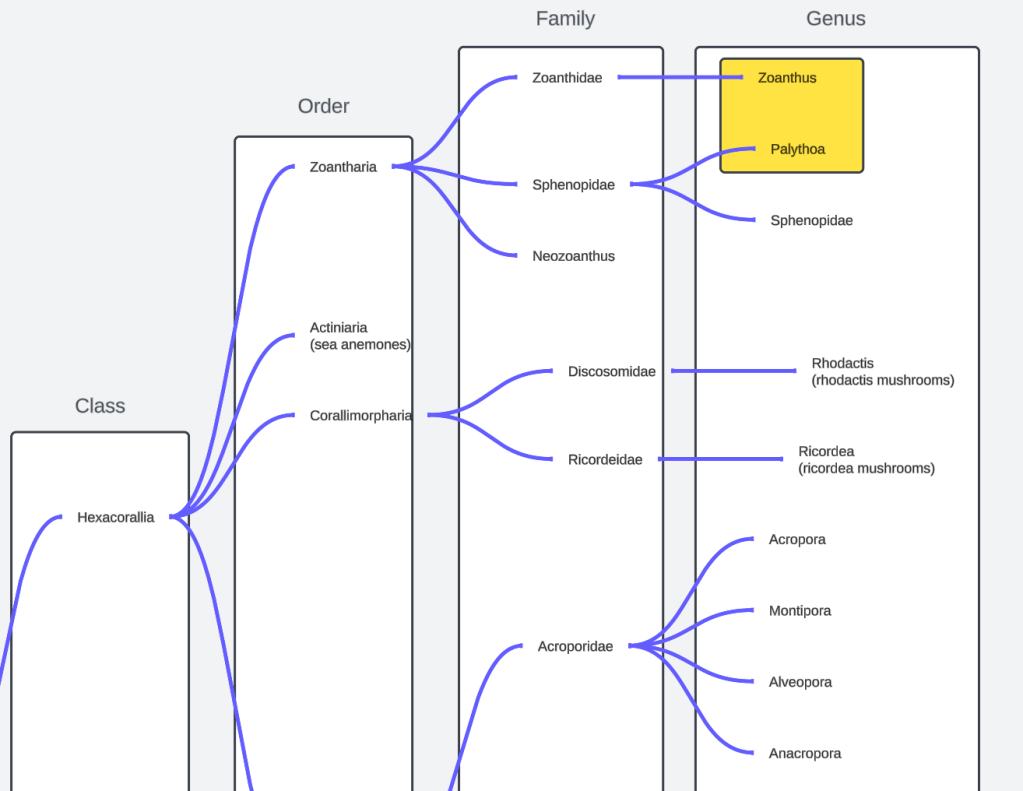
This is not an exhaustive taxonomy tree of all corals, but I highlighted a few of the major coral types most hobbyists may know about such as mushrooms, acros, zoas, gonis, etc. It is also worth noting that the entire sub-Phylum of Anthozoa is shifting with new research in genetics, and relationship mapping due to this work. The part we are talking about here with Zoanthids is in yellow. A bit more focused.
There are some 120+ species of Zoanthus today, and even more under Palythoa. An example of a particular interest for the home hobbyist is the existence of Palytoxins (PLTX’s), which appear to be more prevalent within the genus Palythoa. An article published in PLoS One shows how Palythoa spp samples contain PLTX’s while Zoanthus spp do not.

Zoanthus in blue, Palythoa in red and green.

Additional works (and here) showing that Palythoa heliodiscus, Palythoa tuberculosa, and Palythoa toxica contain PLTX’s, including additional related toxins hydroxyPLTX and deoxyPLTX. Interestingly, PLTX and PLTX like substances can be consumed through seafood and dinoflagellate blooms (from Ostreopsis spp).
While I do not personally find Palythoa’s that seem to be the main culprits of PLTX risk appealing in a reef tank, personal preferences on the attractiveness of coral varies. If you are going to house Palythoa spp, I would suggest running activated carbon 24/7, as this has been shown to reduce the presence of PLTX within aquarium water by 99.7%. And as with most recommendations on Paly’s goes, wear gloves, eye and respiratory protection when handling these corals.
So how do we determine the difference between Palythoa spp and Zoanthus spp if we want to avoid Palythoa’s? This appears to be difficult at best, as much is determined at a genetic level. It does appear safe to assume smaller samples are Zoanthus though. A research paper on the diversity of Zoanthid’s around Florida show two examples of Palythoa (Palythoa grandis, Palythoa variabilis):
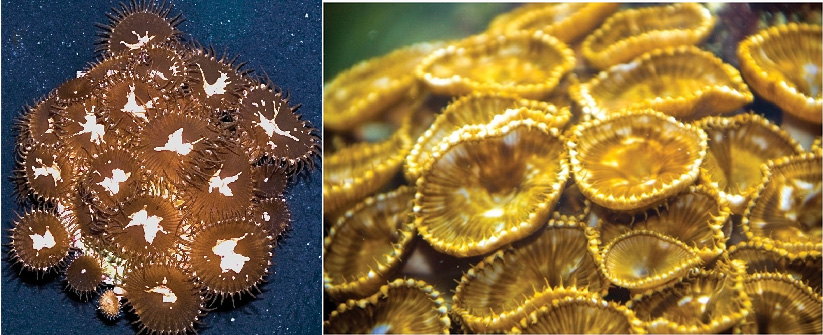
And examples of Zoanthus (Zoanthus sociatus, Zoanthus pulchellus, Zoanthus solanderi):
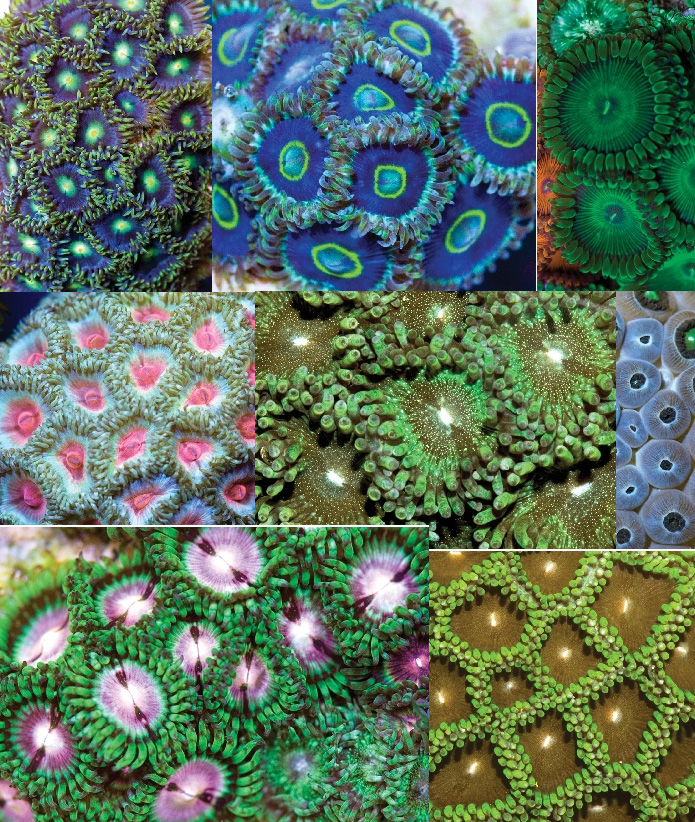
Simply based off of visual appearances, most of the “zoas” for sale I see would fall into the latter category of Zoanthus. Browsing online coral vendors seems to be all over the map though, with some classifying “palys” as any Zoantharia with larger heads and smaller ones as “zoas”. Some varieties are even listed as both Paly’s and Zoa’s!


 AstroReefer
Leave a comment